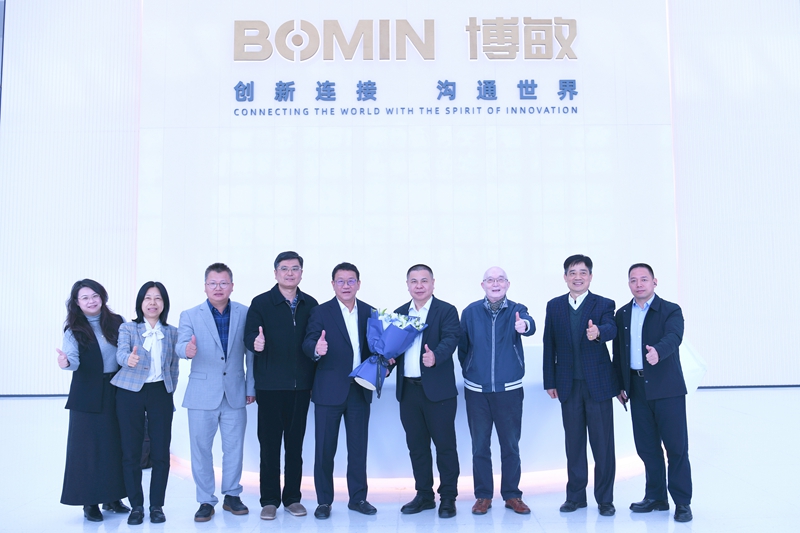

On January 27, Dr. Jiang Xugao, Partner of the globally authoritative PCB industry analysis firm Prismark, visited Chuangxin Intelligent Manufacturing Park and delivered an annual public-interest report titled "AI's Challenges and Opportunities for the PCB Industry." The event attracted significant attention from within and beyond the sector. Over 260 individuals attended in person across the main venue in Meizhou and branch venues in locations such as Shenzhen and Jiangsu, while 200 online meeting slots were quickly filled, reflecting the industry's keen interest in the transformations driven by AI.
Senior PCB expert Mr. Wu Anfu, Group Chairman Mr. Xu Huan, Meizhou Science and Technology Bureau Director Mr. Xu Wanbao, GPCA Secretary-General Mr. Xiang Baichun, as well as leaders and representatives from industry associations including MPCA and HKPCA, attended the event to discuss the future of the industry.
In his welcome remarks, Chairman Xu noted that AI technology is pushing the PCB industry toward a new cycle of growth. Facing both rapid expansion and high technical demands in areas such as AI servers, the company adheres to a "technology-first" strategy. It has overcome key technologies including 20+ layer AI server boards, embedded component technology, and 15-micron fine-line circuitry, achieving mass production in several high-end applications. He expressed hope that such high-quality industry exchanges would pool wisdom to jointly advance the industry's high-quality and intelligent development.
In his presentation, Dr. Jiang Xugao systematically elaborated on how AI, as a core driver, is profoundly reshaping the global electronics supply chain, particularly the PCB industry. He pointed out that while AI investment is currently experiencing explosive growth, the benefits are distributed unevenly. Regions and enterprises deeply embedded in the AI supply chain are gaining unprecedented development opportunities.
Dr. Jiang analyzed that AI's requirements for PCB technology have shifted from functional implementation to "performance maximization," triggering a chain of changes: first, product portfolios are moving upmarket, with the value of AI server PCBs surging, making high-layer-count and advanced HDI boards mainstream; second, material demands face extreme challenges, leading to structural shortages of high-end specialty materials; third, supply chains and processes are under pressure, raising the bar for suppliers' comprehensive capabilities and potentially leading to further industry consolidation.
Looking ahead, Dr. Jiang believes AI's influence is expanding from data centers into broader fields. High-speed networking equipment and low-earth-orbit satellite communication will become new growth drivers for high-end PCBs, while in the long term, the rise of consumer AI hardware will open new market space for products like flexible printed circuits.
During the following Q&A session, both online and on-site participants actively raised questions regarding AI's application in manufacturing, competition in niche markets, technological limits, and emerging trends such as glass substrates. Dr. Jiang provided insightful answers supported by detailed data and industry analysis, fostering a lively exchange.
This report provided a high-quality platform for idea exchange and strategic guidance at a critical juncture in the PCB industry's intelligent transformation. As the initiator and host, the company demonstrated its open approach to connecting with top industry thinkers and collaborating with peers for shared progress. The company will continue to build such exchange platforms, focus on cutting-edge technologies, work with industry partners to address challenges and seize opportunities, and remain committed to advancing the PCB industry's transformation, upgrading, and sustainable development in the AI era.